Qatar .qa Domain Policies 2026: A Complete Guide to the New Rules
Understand who can register a Qatar domain, what happens to existing domains, and how eligibility checks, transfers, renewals, disputes and domain recovery work under the revised policies.
Effective 22 October 2026 · For registrants, businesses and domain resellers
Qatar's domain name system has entered a new chapter. The Qatar Domains Registry (QDR), operated by the Communications Regulatory Authority (CRA), has introduced a revised policy framework alongside a new registry management platform effective 22 October 2026.
The rules affect second-level .qa registrations, restricted extensions such as .com.qa and .net.qa, and the Arabic-script domain .قطر. They introduce eligibility checks, revised transfer procedures, updated renewal and deletion stages, and clearer obligations concerning ownership, security, privacy and disputes.
CRA has clarified that eligibility must be verified before applicable changes to an existing domain registration. If a registrant does not meet the requirements when verification is triggered, the registrar must delete the domain, which enters the 30-day Redemption Period. Existing domains are not automatically cancelled solely because the new rules have taken effect.
01 Understanding Qatar's Domain Name System
The Qatar Domains Registry operates and maintains Qatar's country-code domain system and sets the policies governing registrations. Three parties play distinct roles:
Who operates and provides the service?
QDR maintains the authoritative domain database. Accredited registrars, such as QHost, process and manage registrations for customers. Resellers may work through accredited registrars.
Who holds the registration?
The individual or organization recorded as registrant holds the registration rights, subject to the registry's policies and agreement.
Is a domain name permanent property?
The registry policies describe domain registrations as exclusive licences to use a domain for a defined period. Registering example.qa therefore gives a registrant exclusive registration rights for the term, but not unrestricted permanent property ownership or automatic trademark rights.
Registrants must continue to satisfy the applicable rules and provide accurate information throughout the registration.
Policy reference: Registration, Expiry, Renewal and Deletion Policy, Sections 5.1 and 5.6.
02 New Eligibility Requirements for .qa Domains
Previously, second-level .qa names were available to individuals and businesses worldwide without documentary proof of a Qatar connection. Under Section 5.17 of the revised registration policy, new applicants must now qualify under an approved eligibility category.
| Applicant category | Examples of qualifying documentation |
|---|---|
| Commercial businesses | Qualifying Commercial Registration (CR), trade licence or trademark evidence |
| ICT businesses and providers | Relevant commercial/ICT registration or qualifying trademark rights |
| Individuals | Qatar ID (QID) or residency permit |
| Organizations | Appropriate sporting, charitable, public or religious organizational documentation |
| Schools and universities | Recognized educational registration or official authorization |
| Government and military | Relevant official authorization |
Can applicants outside Qatar still register?
International applicants may qualify if they satisfy an applicable category. Foreign residence or foreign company registration alone does not establish eligibility. For example, a business with qualifying trademark rights in Qatar may qualify under the relevant commercial rules.
Does any foreign trademark qualify?
Not automatically. The relevant commercial provisions refer to trademark rights in Qatar. Applicants should confirm whether their evidence meets the actual criteria before ordering.
A domain can be technically available while the applicant is not entitled to register it. Availability checks and eligibility assessment are two different steps.
Policy reference: Registration Policy, Sections 5.17–5.25.
03 Registration and Document Verification
CRA has clarified that accredited registrars may continue their existing workflows while ensuring the necessary documents are reviewed. This means a registration can be processed before final document verification, or the registrar may choose to verify the applicant first.
How the five-day Add Grace Period works
Submit the applicationThe customer selects a domain, identifies the correct eligibility type and supplies registration details.
Process the registrationThe registrar can submit the registration under its approved operational workflow.
Collect and review documentsThe registrar checks official evidence and may request more information.
Confirm or cancelIf the customer qualifies, the domain can be retained. A qualifying registration that fails verification can be deleted during the five-day Add Grace Period with a full registry fee refund.
Instant technical registration does not mean permanent approval. An application can fail verification after the domain has initially been activated.
The five-day deletion refund is a registry-level transaction between QDR and the registrar. Customer cancellation and refund rights remain subject to the registrar's applicable terms.
Accredited registrars must collect and retain the supporting documents throughout the validity of the registration and make them available to CRA when required.
Policy reference: Registration Policy, Sections 5.8, 5.17 and 5.29; CRA implementation clarification issued 21 October 2026.
04 What Happens to Existing .qa Domains?
CRA has confirmed that existing domains will continue under the new registry platform's automatic renewal process. They are not automatically cancelled on 22 October 2026 solely because the eligibility rules changed. But they are not permanently exempt either.
Eligibility verification before modifications
CRA has instructed registrars to complete eligibility verification before modifying existing registration information, including applicable DNS updates. Such changes can include registrant or contact changes, nameserver updates and other registry-connected modifications.
CRA's implementation guidance states that the registrar must delete the domain and the domain will enter the 30-day Redemption Period. The domain may stop resolving, interrupting its website, email and connected services. Certain separate policy-enforcement deletions can have different consequences.
Existing registrants, particularly those outside Qatar, should check their eligibility before requesting changes. Automatic renewal is not proof of eligibility.
05 Nameserver Changes vs. DNS Record Updates
Nameservers determine which DNS service is authoritative for a domain. Individual DNS records direct websites, email and other services.
| Operation | Normally requires a registry EPP transaction? |
|---|---|
| Changing authoritative nameservers | Yes |
| Changing the registered holder | Yes |
| Updating registry contact information | Yes |
| Editing an A, MX, TXT or CNAME record at an independent external DNS provider | Normally no, if registered nameservers stay unchanged |
CRA's clarification refers broadly to DNS updates, so technical independence from EPP should not be interpreted as a blanket policy exemption. Using external DNS does not exempt a registrant from eligibility rules.
If your website and email are working correctly, avoid unnecessary nameserver changes. For any planned migration, prepare complete DNS records and review eligibility before initiating registry-level changes.
06 Understanding Qatar's Domain Extensions
| Extension | Intended applicants |
|---|---|
| .qa | Applicants meeting an approved eligibility category |
| .com.qa | Qualifying commercial businesses and trademark holders |
| .net.qa | Eligible ICT businesses and providers |
| .name.qa | Eligible Qatar citizens and residents |
| .org.qa | Qualifying non-profit and public-benefit organizations |
| .edu.qa / .sch.qa | Eligible higher education institutions and schools |
| .gov.qa / .mil.qa | Government and military entities |
| .قطر | Eligible applicants under the Arabic-script provisions |
Not every extension uses the same application route. The revised policy provides for .qa, .com.qa, .net.qa, .name.qa and .قطر through accredited registrars, while certain restricted categories are handled directly by the registry.
What about .com.qa hosting?
The previous registration policy expressly required .com.qa domains to be hosted locally in Qatar, but the same wording is not repeated in the revised document. This omission alone should not be interpreted as removing all other possible regulatory or hosting-location obligations.
07 Registration Terms: Up to 10 Years
The revised policy allows registration for terms of up to 10 years, with renewals also subject to a maximum combined remaining period of 10 years.
This provides more flexibility for long-term domain planning, although individual registrars may offer a smaller range of ordering terms. Longer registration also does not exempt the registrant from ongoing eligibility and compliance requirements.
Policy reference: Registration Policy, Sections 5.5 and 5.32.
08 Transferring a Domain Between Registrars
Although a separate fee merely for the transfer is not permitted, the gaining registrar must pay the mandatory one-year renewal fee and may charge the customer for that renewal.
Transfers require the proper authorization, including the relevant domain password or authorization code and registrant confirmation. They must not be initiated without meeting the required procedures.
Policy reference: Domain Name Transfer Policy, Sections 5.5–5.8.
09 Changing Registrants vs. Changing Registrars
Registrar transfer
Moves management of the domain between accredited registrars, without necessarily changing the registered holder.
Registrant transfer
Changes the individual or organization recorded as the domain holder and requires the relevant authorization and eligibility evidence.
The revised transfer policy identifies specific legitimate circumstances in which a registrant change may be permitted. These can include a documented business sale, an intellectual-property transaction, insolvency proceedings, transfers between subsidiaries, a transfer from an agent who originally registered on a client's behalf, legal or personal circumstances, a court order, or a documented dispute settlement.
The proposed new registrant must still satisfy the applicable eligibility requirements and provide required authorizations and supporting documents.
Policy reference: Domain Name Transfer Policy, Sections 5.2–5.4.
10 Restrictions on Selling, Renting and Leasing
The revised registration policy expressly restricts selling, renting or leasing second-level .qa domains to third parties.
That restriction should be considered together with the separate provisions permitting certain properly documented changes of registrant, such as a domain included in a legitimate business acquisition.
Do not assume that a stand-alone domain aftermarket sale and an authorized transfer as part of a business transaction are treated the same way. Review the applicable policy provisions before entering an arrangement.
11 Renewals and Registry Grace Periods
| Lifecycle stage | Duration | Main purpose |
|---|---|---|
| Add Grace Period | 5 days | Qualifying cancellation after a new registration |
| Renew Grace Period | 5 days | Reversal of qualifying renewal transactions |
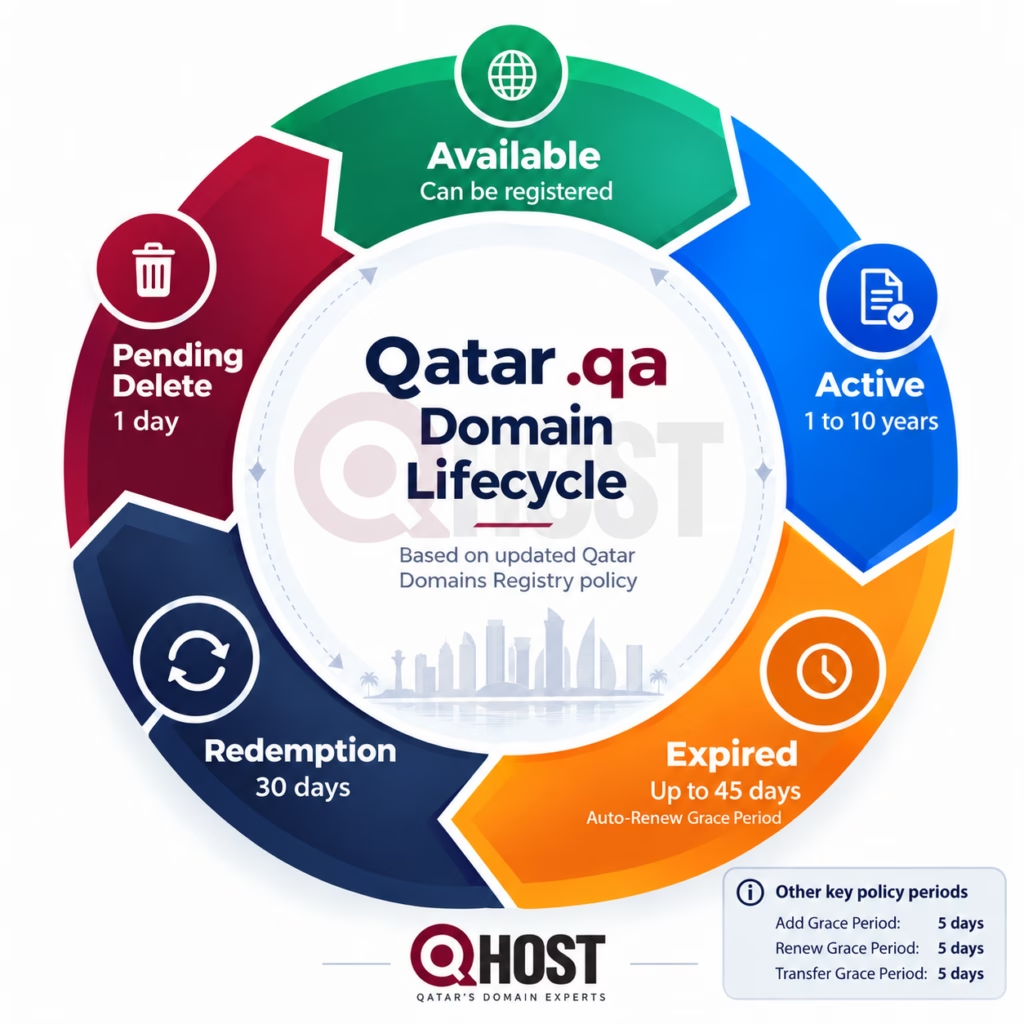
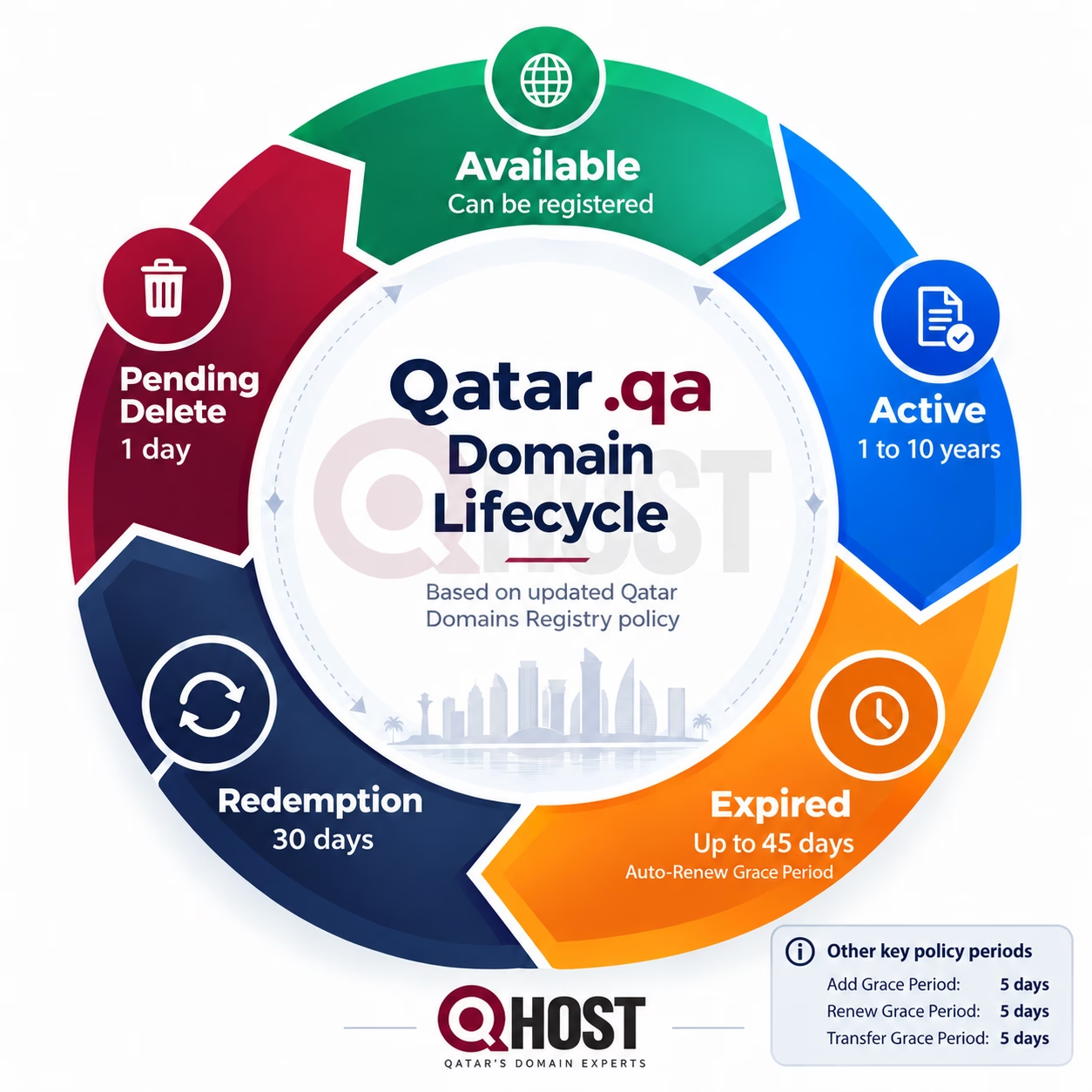
| Auto-Renew Grace Period | 45 days | Registry automatic renewal and billing management |
| Transfer Grace Period | 5 days | Post-transfer registry transaction stage |
| Redemption Period | 30 days | Recovery of eligible deleted domains |
| Pending Delete | 1 day | Final deletion stage before purge eligibility |
What does automatic renewal actually mean?
At expiry, the registry automatically renews a domain for one year at the registry level and provides a 45-day Auto-Renew Grace Period. During that period the sponsoring registrar may delete the domain and reverse the automatic registry renewal without incurring the corresponding charge. Otherwise, the charge is applied according to the policy.
These are registry-level stages, not a promise of free service or an extension of your registrar's payment deadline. Customers must still pay renewal invoices and comply with their provider's terms.
12 Deleted Domains, Redemption and Restoration
For eligible domains deleted outside their initial registration grace period, the revised lifecycle introduces a 30-day Redemption Period. During redemption, a domain is inactive, removed from the registry DNS zone and unavailable for public re-registration.
Deletion and redemptionThe deleted domain enters redemption. Its website and email may stop working.
Potential restorationThe sponsoring registrar may request restoration within the 30-day period, subject to the applicable procedures and fees.
Pending DeleteAfter redemption ends, the domain enters a one-day Pending Delete stage.
Possible releaseThe domain becomes eligible for permanent removal and eventual re-registration.
Restoration is not free. The revised policy treats restoration during redemption as a new registration for fee purposes and requires a restoration report within the prescribed seven-day period. Failure to complete the report can return the domain to redemption without refunding the restore fee.
Not every deletion is recoverable. Certain policy-enforcement actions can have immediate permanent effects.
Redemption is a recovery process, not an extra free renewal period. Renew important domains before their expiry dates.
Policy reference: Registration Policy, Sections 5.29–5.35.
13 Reserved, Prohibited and Misleading Domain Names
Technical availability does not always mean a name is permitted. The registry's restrictions may cover reserved government or geographical names, protected trademarks, famous individuals' names without authorization, misleading names, names linked to fraud or illegal activity, and names contrary to applicable law or public order.
Registration does not grant trademark rights. Applicants remain responsible for avoiding infringement, and a registered name can be challenged under the applicable procedures.
14 Registrant Ownership, Contacts and Account Control
The registrant is the person or organization recorded as holding the domain registration rights. The account holder is whoever controls the registrar's customer account. These may be different parties.
The Registrant Contact must represent the actual registrant, not simply the sponsoring registrar or its reseller. A Technical Contact may be an authorized representative or provider.
Business name is registrant
A company registers its domain in its own legal name, and an agency manages it under authorization.
Agency is registrant
A contractor registers a client's business domain in the contractor's own name, creating ownership and access complications later.
Invoices, account access and website administration rights do not necessarily establish registrant rights. Businesses should confirm their actual registry records and retain appropriate authorization documentation.
15 Domain Password and Transfer Security
The revised Domain Name Password Policy requires domain passwords or transfer credentials to:
- Contain 8 to 32 characters.
- Include at least one letter and one digit.
- Not be a dictionary word.
These credentials should be handled securely and disclosed only through the applicable authorization procedures. Do not share transfer codes publicly or with unauthorized parties.
Policy reference: Domain Name Password Policy, Sections 5.1–5.5.
16 WHOIS, Privacy and Personal Information
The revised WHOIS policy addresses the collection, use, accuracy and permitted disclosure of registration information for processing domain operations, contact, complaints, lawful requests and lookup services.
| Public WHOIS field | Information shown |
|---|---|
| Domain | Registered domain name |
| Registrar | Sponsoring registrar |
| Status | Registry status information |
| Registrant Contact Name | Name of the registrant contact |
| Technical Contact Name | Technical contact |
| Name Servers | Authoritative nameservers |
| Arabic variants (where applicable) | Active domain name variant information |
Copies of QID or company certificates are not listed among these standard public WHOIS fields. That does not prevent disclosure to CRA or legally authorized parties under applicable requirements.
Where documents are required, customers should ask their provider how they are securely submitted, stored, accessed and retained. The registry also requires accurate registrant information.
17 Disputes, Trademarks and Complaints
The revised framework includes a Domain Name Dispute Resolution Policy and procedural rules. Trademark-based disputes can be referred through the applicable administrative process, with the WIPO Arbitration and Mediation Center identified as a provider under the policy.
What must a trademark complainant establish?
- The domain is identical or confusingly similar to a mark in which the complainant has rights.
- The registrant lacks rights or legitimate interests in the name.
- The domain was registered or is being used in bad faith.
Depending on the decision, a domain may be cancelled or transferred. Registrars do not independently decide contested trademark rights merely on the basis of invoices, screenshots or competing ownership statements.
The separate Complaints Handling Policy also provides processes for certain complaints about registrar and reseller conduct. Routine hosting, billing and technical issues should generally be raised with the service provider first.
18 Acceptable Use and Registry Security
The Acceptable Use Policy protects registry systems against unauthorized access, authentication bypass, interference and disruptive activity. The Registry System and Zone Files Access Policy governs permitted technical access to registry information and DNS zone-file data.
These obligations are especially relevant to accredited registrars, resellers and technical service providers accessing registry-connected services.
19 Arabic-Script Domains Under .قطر
Qatar's Arabic-script namespace .قطر permits eligible applicants to register Arabic domain names. The revised eligibility categories correspond to those used for .qa, alongside applicable character, script and technical requirements.
The policy also covers Arabic domain variants, since different character representations can resemble each other. Variants may be linked to a primary Arabic domain and subject to activation or management restrictions, rather than being independently transferable.
20 Legacy Domains and Policy Definitions
The CRA policy index also includes a Legacy Domain Names Policy addressing registrations from before the earlier registry system and a Definitions and Glossary document defining terms such as Registrant, Registrar, Domain Name Licence, Transfer, Renewal and Redemption.
Legacy rules are relevant mainly to older registrations and should not be assumed to override the current eligibility and compliance framework.
21 Frequently Asked Questions
Open any question below for a concise answer.
Can anyone worldwide register a .qa domain?
Not under the former unrestricted model. Applicants must satisfy the applicable eligibility category and provide required documentation.
Can foreigners qualify for a .qa domain?
Potentially yes, if they meet an approved eligibility category. Residence outside Qatar alone does not establish eligibility.
Does a foreign trademark automatically qualify?
Not necessarily. The relevant commercial provisions reference rights in Qatar. Check the applicable trademark evidence before ordering.
Will existing .qa domains automatically be cancelled?
No. Existing registrations continue under the automatic renewal framework, but later modifications can trigger eligibility checks.
Can an existing domain be deleted after failed verification?
Yes. CRA has said that if verification is required for a modification and the registrant is ineligible, the registrar must delete the domain. It then enters the 30-day Redemption Period under CRA's implementation guidance.
Can I renew my existing domain?
Existing domains continue within the registry's automatic renewal lifecycle, subject to payment and applicable compliance requirements.
Does automatic renewal mean I can ignore the invoice?
No. Customers must still pay their registrar's renewal fees within the applicable deadlines.
Can I change my nameservers?
Nameserver changes require registry-level updates and can trigger eligibility verification under the revised requirements.
Can I edit A, MX and TXT records at an external DNS provider?
Such changes normally do not require EPP transactions when registered nameservers are unchanged. This technical distinction does not create a general policy exemption.
Are registrar transfers free?
A separate transfer fee is prohibited, but a mandatory one-year renewal is required and can be charged.
What if I change the registered domain holder?
The change must meet the relevant eligibility, authorization and documentation requirements. Some legitimate business or legal transfers may qualify.
Can I sell or rent a .qa domain?
The revised policy restricts sales, rentals and leasing of second-level .qa names. Specific documented changes of registrant may still be permitted.
How long can a Qatar domain registration last?
Up to 10 years under the revised maximum permitted term, subject to your registrar's offered options.
Can a deleted .qa domain be restored?
Qualifying deletions may enter a 30-day Redemption Period, with restoration subject to applicable conditions and fees. Not all deletions are recoverable.
Must document verification happen before registration?
Not universally. CRA permits accredited registrars to retain their workflows while completing verification, including during the five-day Add Grace Period.
22 Practical Checklists for Domain Owners
New applicants
- Confirm your eligibility category.
- Prepare valid identity, business or trademark documents.
- Check for conflicts with third-party rights.
- Use accurate registrant and technical contacts.
- Understand that activation may precede verification.
- Review payment and refund terms.
Existing domain owners
- Keep renewals paid on time.
- Review your eligibility before changes.
- Confirm the correct registered holder.
- Prepare evidence for future verification.
- Back up essential DNS records.
- Plan transfers and changes in advance.
Businesses, agencies and resellers
- Register the domain in the correct legal entity's name.
- Retain written authorization for third-party management.
- Keep registrant contact information accurate.
- Review domain rights during company acquisitions and restructuring.
- Ensure staff understand that registrar account access and registration rights are not the same.
23 Official CRA Policies and Next Steps
The updated framework includes Registration/Expiry/Renewal/Deletion, Transfer, Registrant Agreement, Password, WHOIS, Domain Dispute Resolution, Dispute Rules, Complaints Handling, Acceptable Use, and Registry System and Zone File Access policies. CRA's index also includes Legacy Domain Names and Definitions and Glossary resources.
Always consult the official CRA documents for the full legal text and any subsequent amendments.
Read the Qatar Domains Registry policies on the CRA website.
New applicants: Check eligibility before applying and prepare documentary proof. Existing registrants: Automatic renewal continues, but changes can trigger verification, and failing that verification can result in deletion. Everyone: Plan domain transfers, renewals and DNS changes carefully.
Need help with a Qatar domain?
QHost is a CRA-accredited .qa registrar. Our team can help you understand the requirements for an existing domain, a new application or a requested modification.
Visit QHost